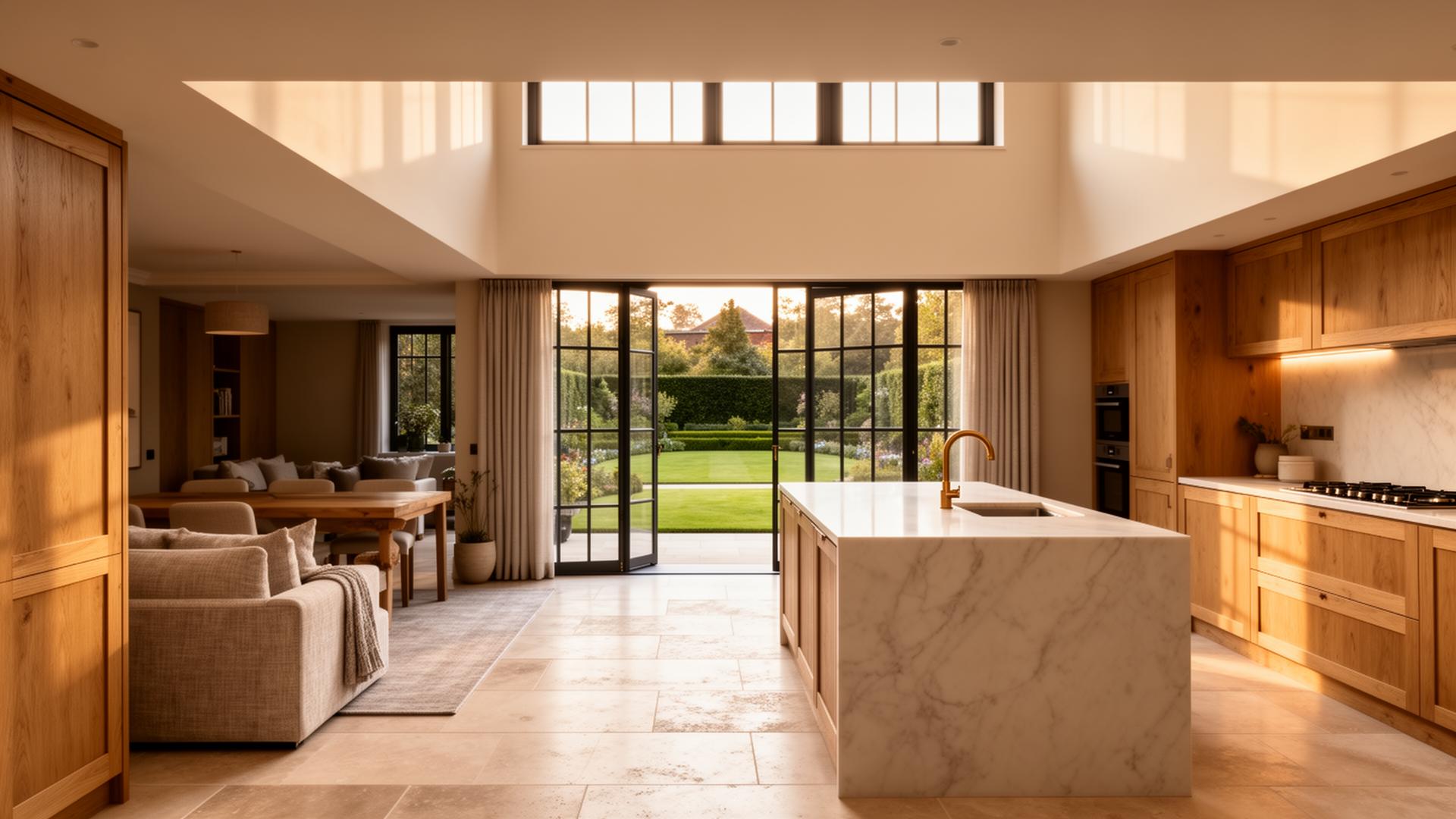


From Florida to Surrey: what designing on the Gulf Coast taught me about English homes
Five years working on luxury estates in Florida, where scale is generous, light is relentless and clients are uncompromising, changed the way I approach every project. Here is what I brought back to Elmbridge, and what still surprises me about designing in Surrey.
By Bal

I established my design practice in 2018, and for the first five years of it I was based in Florida. I worked on private estates on the Gulf Coast, on oceanfront properties in the Palm Beach area, and on a handful of extraordinary homes in between. It was a formative education in luxury residential design at genuine scale, houses of eight, ten, twelve thousand square feet, clients who had seen the best work in the world and expected it, and a design culture that was expansive, sun-filled and entirely unapologetic about ambition.
When I relocated to Surrey in September 2024, I expected the adjustment to be mostly logistical. I did not expect it to reshape the way I think about rooms.
What Florida taught me about scale
Designing in Florida trains you to think generously. The floor plans are large, the ceiling heights are high, and the relationship between interior and exterior space is constant, almost every principal room reaches out to a terrace, a pool deck or a garden. You learn to design for movement, for the way people actually live in a house rather than how they imagine they will.
You also learn about materiality under pressure. Florida's climate is extreme, the humidity, the heat, the light. Materials that might seem perfectly appropriate in a European context fail there. You become very particular about what you specify, very attentive to how things perform rather than simply how they look in a sample book. That rigour has stayed with me.
You learn to design for the way people actually live in a house, not the way they imagine they will.
What Surrey taught me about restraint
English domestic architecture is quieter than American domestic architecture. This is not a criticism, it is a quality, and one I have come to admire enormously. The proportions are more considered, the relationship between rooms more intimate, the light, and this is the thing that struck me most forcefully on arrival, entirely different.
Florida light is emphatic. It does not ask permission. Surrey light is oblique, seasonal, sometimes thin, and it asks a completely different set of questions of a designer. Where Florida rooms can absorb bold material choices without losing their character, Surrey rooms require more care. A strong decision in a room with northern light can feel oppressive in a way that the same decision in a sun-filled space would never be.
I found, in my first months here, that I was editing more. Not removing ambition from projects, but finding more precise ways to express it. The English interior rewards specificity. The exact tone of a wall, the exact weight of a curtain, the exact profile of a skirting board, these things matter more, not less, when the light is gentler.
What the two places have in common
The clients, in both places, want the same thing: a home that feels like it was made for them, by someone who listened. The scale is different, the light is different, the architectural vernacular is entirely different. But the desire for a home that is calm, that is beautiful, that holds its quality over decades rather than seasons, that is universal.
I brought back from Florida a confidence in generous spatial planning, a discipline around material specification, and an understanding that the most discerning clients are not impressed by complexity. They are impressed by things that work, rooms that feel right from the first morning you live in them, kitchens that age gracefully, bathrooms that remain beautiful long after the renovation photographs have faded.
Surrey has given me an education in a different kind of excellence. One that is quieter, more layered, more connected to the particular character of a place and a climate. I find that the two vocabularies speak to each other well.
Elmbridge, it turns out, is an exceptionally good place to practise both.